
In an age dominated by CAD, BIM, and AI tools, hand drawing remains an essential part of our architectural design process. At Group Emmett Design Architects, hand drawing isn’t just a way to illustrate ideas, it’s a core element of how we think, explore, and communicate our designs, whether for historic, listed buildings or contemporary architectural projects.
Hand Drawing as a Thinking Tool
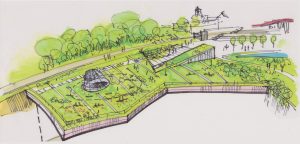 Hand drawing engages both mind and body in a unique way. The hand-eye coordination required to sketch forces us to slow down, and make deliberate design decisions. Every line, curve, and mark is an opportunity to test and re-test ideas, uncover subtle spatial relationships, and explore forms before moving into digital modelling.
This iterative process isn’t just about producing an image, it’s about thinking through design problems. Sketching allows ideas to evolve organically, revealing creative solutions that might not emerge through CAD or AI alone. Whether refining the proportions of a modern extension or understanding the irregularities of a historic building, hand drawing helps us develop designs that are thoughtful, precise, and sensitive to context.
Communicating Ideas with Clarity and Impact
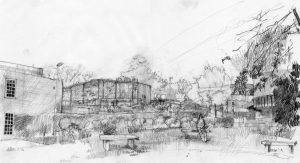 While digital tools can produce flawless visualisations, hand drawings offer a relatable language for design. Sketches and drawings can communicate intention in a way that is immediate, intuitive, and approachable.
Clients, planners, and conservation officers often respond positively to sketches because they show a design in progress, rather than as a fixed or overly perfected model. This openness fosters dialogue, encourages feedback, and ensures that every project benefits from collaborative input. Hand drawings help stakeholders understand and connect with both heritage and contemporary projects, making the design process more inclusive and engaging.
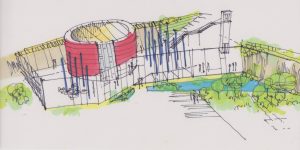
Creativity, Exploration, and Expression
Unlike digital tools, which can sometimes encourage precision over experimentation, sketching invites us to explore, test, and improvise. Imperfections become part of the discovery process, often leading to unexpected insights and innovative solutions. From conservation projects to contemporary architectural designs, hand drawing allows us to capture ideas that are expressive, spatially aware, and deeply rooted in human perception. It is a tactile, reflective practice that enhances both design quality and architectural storytelling.
Balancing Tradition and Technology
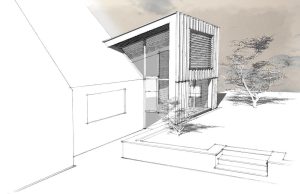 At Group Emmett Design Architects, hand drawing is fully integrated with modern digital workflows. Early sketches guide concept development, material studies, and spatial exploration, while CAD, BIM, and AI tools refine geometry, analyse performance, and produce construction – ready documents.
This hybrid approach ensures our designs are both innovative and technically rigorous, combining the cognitive and creative strengths of hand drawing with the precision and efficiency of modern technology. It allows us to respond sensitively to historic fabric while pushing boundaries in contemporary design.
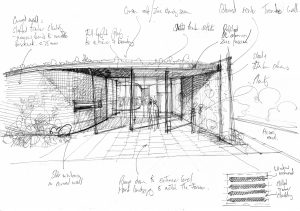
Designing with Insight
Hand drawing is not nostalgic, it’s a strategic and practical tool that enhances every stage of architectural design. By combining observation, iterative testing, and expressive communication, it allows us to connect with the unique qualities of each building, from the layered history of listed structures to the dynamic forms of modern architecture.
#GroupEmmettDesign #Architects #ArchitecturalDesign #HandDrawing #DesignProcess #ContemporaryArchitecture #HeritageArchitecture #Conservation #ListedBuildings #Sketching #CAD #BIM #AIinArchitecture #CreativeProcess #HybridDesign